Art Conservation Capstone
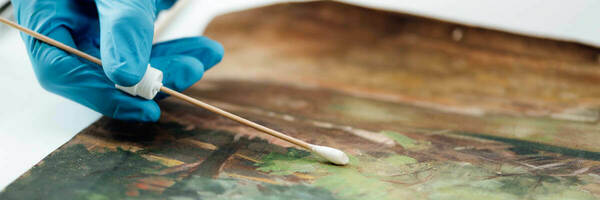
Art Conservation track students are required to complete a 1-credit capstone project during the final year of their coursework. These projects ask students to engage more deeply with the materiality of art. That is, they ask students to move beyond the classroom in order to think concretely about conservation and related issues.
Each student will plan and develop a project relevant to their intellectual and professional interests with the help of a faculty or staff mentor, who will be the instructor of record and evaluate the final product. Capstone projects may build on a course, internship, research project, or service program, or they may be a separate project. Each one represents 30-40 hours of work throughout a semester (approx. 2 hours/week).
Capstone projects may take a wide variety of forms such as a public poster presentation or talk, online digital project, curated museum or library exhibit, podcast, video, interview and research paper, or the organization, reflection/research and introduction of public programming such as a panel discussion or visiting speaker.
Art history will seek opportunities for conservation and materiality studies that may incorporate collaboration with the Raclin Murphy Museum, the Museum of Biodiversity, or the College of Arts & Letters.
Capstone Project Contacts:
Raclin Murphy Museum of Art
Cheryl Snay, Curator of European Art, csnay@nd.edu
Bridget Hoyt, Curator of Education, bobrien2@nd.edu
Chemistry and Physics
Bahram Moasser, Department of Chemistry and Biochemistry, bmoasser@nd.edu
Katchatur Manukyan, Department of Physics, kmanukya@nd.edu
Preservation Department, Hesburgh Libraries
Liz Dube, Department Head, Preservation and Conservation, ldube@nd.edu
Jen Hunt Johnson, Special Collections Conservator, jhuntjoh@nd.edu
Museum of Biodiversity, Department of Biological Sciences
Barbara Hellenthal, Curator, bhellent@nd.edu
Tips for Finding an Advisor
Conservation capstone advisors can be professors, librarians, staff, internship advisors, or anyone with the expertise and interest to work with you on a project. Professors do not have to be affiliated with Art, Art History, and Design. Consider who you enjoy working with, who has expertise in the subject area and/or research methodology you would like to use, or with the type of project you would like to create (see below). Approach them first for their advice and make sure they are familiar with the conservation track and the idea behind our capstone requirement first, talk with them about your ideas, and then ask them if they would be willing to serve as your advisor.
Research Funding
Notre Dame offers several funding programs to support undergraduate research. View available funding opportunities here.