Requirements
B.A. in art history B.A. with honors in art history Supplementary major in art history Minor in art history
Download Art History advising sheet (enrolled 2022 and beyond)
Download Art History advising sheet (enrolled 2019–2021)
Bachelor of Arts, art history
The Bachelor of Arts degree program in art history is a 30-credit-hour major. In addition to the one-course university requirement, the major in art history is 10 courses. Of these, the only requirement involves varying the course level at which you take classes: 2 at the 20000-level; 4 at the 30000-level or above; and 1 at the 40000-level. The other three are up to you.
There are no requirements on how any of the courses are distributed. Instead, your advisor will help you develop an individualized curriculum that corresponds to your own interests and goals. This means that art history is a major that you design for yourself.
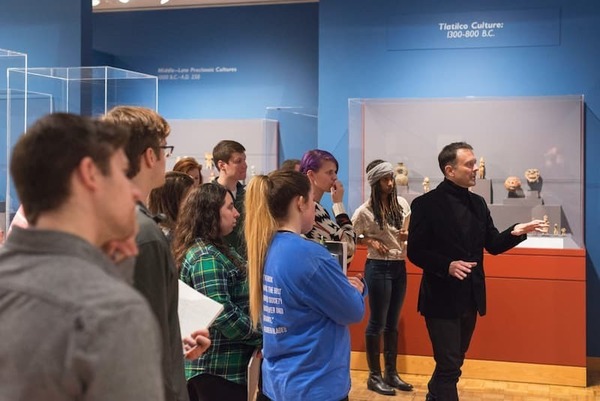
Every art history major has his or her own distinctive curriculum. Many majors especially seek out classes with field trips to museums. It also means that art history is a maximally flexible major, and hence one that is extremely easy to combine with other programs.
It is strongly recommended that the four-course distribution requirement be fulfilled with 200- or 300-level introductory courses taught by regular art history faculty on campus.
Course requirements (10 courses, 30 hours)
Declared an art history major in 2022 or later
- 1 ARHI course at 10000-level or 20000-level
- 1 ARHI course at 20000-level or higher
- Research Methods & Theories (taken sophomore or junior year)
- 3 ARHI courses at 30000-level or higher
- 2 ARHI courses at 40000-level
- 2 ARHI elective courses at any level
Declared an art history major from 2019–2021
- *1 ARHI course at 10000-level or 20000-level
- 1 ARHI course at 20000-level
- 3 ARHI courses at 30000-level or higher
- 2 ARHI course at 40000-level
- 3 ARHI elective courses at any level
*The 10000-level Art history course is our USEM course (art history only).
**Art history electives and seminars may be taken in any period.
Bachelor of Arts with honors, art history
The honors program consists of 33 hours, as compared to 30 hours in the regular art history major. A student with a GPA of 3.5 in the major may request the right to be considered for departmental honors.
Students who wish to be considered for departmental honors must select a thesis advisor and petition the faculty with a one-page letter by the 10th week of the spring semester of the student's junior year. The letter should be addressed to the Director of Undergraduate Studies for Art History. In the letter, the student should give a brief indication of their intended advisor, their proposed senior thesis topic, and their future plans. If the faculty approves, then in place of one of the elective art history courses the student will sign up for six credit-hours of the honors thesis course in her/his senior year — three credits in the fall and three credits in the spring.
Course Requirements (11 courses, 33 Hours)
Enrolled in 2022 or later
- *1 ARHI course at the 10000-level or 20000-level
- 1 ARHI course at the 20000-level
- Research Methods & Theories (taken sophomore or junior year)
- 3 ARHI courses at the 30000-level or higher
- 2 ARHI courses at the 40000-level or higher
- 1 ARHI elective course at any level
- 2 ARHI honors thesis courses (fall and spring of senior year)
Enrolled from 2019–2021
- *1 ARHI course at the 10000-level or 20000-level
- 1 ARHI course at the 20000-level
- 3 ARHI courses at the 30000-level or higher
- 2 ARHI course at the 40000-level
- 2 ARHI elective courses at any level
- 2 ARHI honors thesis courses (fall and spring of senior year)
*The 10000-level Art History course is our USEM course (art history only).
Supplementary major, art history
Students with a first major in another department can complete a supplementary major in art history.
Course requirements (8 courses, 24 hours)
Enrolled in 2022 or later
- *1 ARHI course at the 10000-level or 20000-level
- 1 ARHI course at the 20000-level
- Research Methods & Theories (taken sophomore or junior year)
- 3 ARHI courses at the 30000-level or higher
- 2 ARHI courses at the 40000-level
Enrolled from 2019–2021
- *1 ARHI course at the 10000-level or 20000-level
- 1 ARHI course at the 20000-level
- 3 ARHI courses at the 30000-level or higher
- 2 ARHI course at the 40000-level
- 1 ARHI elective course at any level
*The 10000-level Art History course is our USEM course (art history only).
**Courses taken for the supplementary major or the minor cannot be counted in more than one university program but may be used to fulfill the University Fine Arts requirement (for students enrolled before 2019).
***Only one course (three credits) in art history taken in a foreign program, exclusive of the Rome and London Program, may be counted toward fulfilling the major or minor requirement. This course may only be used as an “option.” If a student participates in a full-year foreign study program (e.g. Angers and Bologna), then up to 6 credits may be counted towards the major. These will normally be considered as “options.”
Art History minor
Students wishing to minor in art history can do so by taking 5 art history courses. The student must be currently enrolled or have taken an art history course to declare the minor.
Course requirements (5 courses, 15 hours)
Enrolled 2019 and beyond
- *1 at the 10000-level or 20000-level
- 1 at the 20000-level
- 3 at the 30000-level or higher
*The 10000-level Art History course is our USEM course (art history only).